The Authority of a Court to Review and Possibly Invalidate

9e. The Power of the Federal Courts
Not everyone agrees on how much power the judicial co-operative should have. After all, federal judges and justices are appointed, not elected. Equally most Americans believe in democracy, shouldn't elected officials run the country?
On the other hand, peradventure American government would be fairer if judges had even more power. Because they do not have to worry about reelection, they are relieved of the exterior pressure of public opinion.
After all, the majority is not always right. It is no accident that the Founders provided for elected officials in the legislature and appointed officials in the judiciary. They believed that liberty, equality, and justice are best accomplished past a balance between the two branches of regime.
Checks on Judicial Power
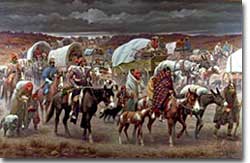
Although the Supreme Court ruled in favor of the Cherokee, its decision was not enforced. Near 4,000 Cherokee died on the Trail of Tears as a result of the Indian removals.
The president and Congress have some control of the judiciary with their power to appoint and confirm appointments of judges and justices. Congress also may impeach judges (but seven take really been removed from office), alter the organisation of the federal courtroom organisation, and meliorate the Constitution.
Congress can besides get around a court ruling past passing a slightly different police force than one previously declared unconstitutional.
Courts likewise have limited power to implement the decisions that they brand. For case, if the president or some other member of the executive branch chooses to ignore a ruling, at that place is very footling that the federal courts can do about it.
For example, the Supreme Court ruled against the removal of the Cherokee from their native lands in 1831. President Andrew Jackson disagreed. He proceeded with the removal of the Cherokee, and the Supreme Court was powerless to enforce its decision.

The Power of the Courts
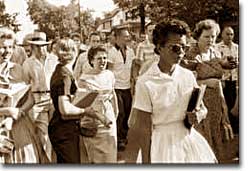
Will Counts/AP
The 1954 Supreme Court decision in Brown v. Board of Education of Topeka regarding integration of schools was not enforced until three years later, when Key High School in Little Rock, Arkansas, was integrated. Elizabeth Eckford, one of the first African American students to attend Central, was heckled on her fashion to school each morning.
The federal courts' most of import power is that of judicial review, the authorization to interpret the Constitution. When federal judges dominion that laws or regime actions violate the spirit of the Constitution, they greatly shape public policy. For example, federal judges take declared over 100 federal laws unconstitutional.
Some other measure out of the Supreme Court's power is its ability to overrule itself. In 1954, the Supreme Court ruled in Brown 5. Lath of Education of Topeka that schools segregated by race were unconstitutional. This reversed the 1896 Plessy five. Ferguson decision that upheld the doctrine of "split up but equal."
For the virtually part, though, federal courts do have a great bargain of respect for previous decisions. A very strong precedent called stare decisis ("let the decision stand up") directs judges to exist cautious most overturning decisions made by past courts.
 | ||
 | An act of the legislature repugnant to the Constitution is void.... It is emphatically the province of the judicial department to say what the law is. Words which, ordinarily and in many places, would exist inside the freedom of speech protected past the Showtime Subpoena, may go subject to prohibition when of such a nature and used in such circumstances as to create a clear and present danger that they will bring about the substantive evils which Congress has a right to prevent. The character of every act depends upon the circumstances in which it is done. The judgments beneath, except that, in the Delaware case, are accordingly reversed, and the cases are remanded to the District Courts to take such proceedings and enter such orders and decrees consistent with this opinion equally are necessary and proper to admit to public schools on a racially nondiscriminatory basis with all deliberate speed the parties to these cases. I shall non today attempt farther to ascertain the kinds of material [pornography] ...[B]ut I know information technology when I come across it. | |
 | ||
Judicial Activism versus Judicial Restraint
The lack of understanding regarding the policy making power of courts is reflected in the debate over judicial activism versus judicial restraint. Judicial activists believe that the federal courts must right injustices that are perpetuated or ignored by the other branches.
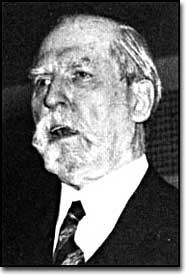
For case, minority rights have often been ignored partly because majorities impose their volition on legislators. Prayers in public schools support the beliefs of the majority but ignore the rights of the minority. The Constitution is oftentimes loosely interpreted to meet the issues of the nowadays. In the words of one-time Justice Charles Evans Hughes, "We are under a Constitution, merely the Constitution is what the judges say it is."
Supporters of judicial restraint point out that appointed judges are immune to public opinion, and if they carelessness their part as conscientious and cautious interpreters of the Constitution, they become unelected legislators. According to Justice Antonin Scalia, "The Constitution is not an empty canteen....It is like a statute, and the meaning doesn't change."
Despite the debate over what constitutes the appropriate amount of judicial power, the United States federal courts remain the nigh powerful judicial system in earth history. Their power is enhanced by life terms for judges and justices, and they play a major part in promoting the core American values of freedom, equality, and justice.
QUIZ Time: The Judicial Co-operative
Source: https://www.ushistory.org/gov/9e.asp
0 Response to "The Authority of a Court to Review and Possibly Invalidate"
Post a Comment